How it works
The short version
A chat model is trained to read text laid out in one exact way. Think of a form where every box has its place. The model’s maker publishes a small program, the chat template, that lays your conversation out in that format.
By the time your words reach a model in Ollama, that layout has been copied twice:
- The maker’s original. It lives on the maker’s Hugging Face page.
- The copy inside the model file. It’s made when someone converts the model into the GGUF file format that Ollama and similar apps use.
- What Ollama actually uses. Ollama packages often carry their own version of the template, in a different language (Go instead of Jinja). A rule inside Ollama decides which one to use.
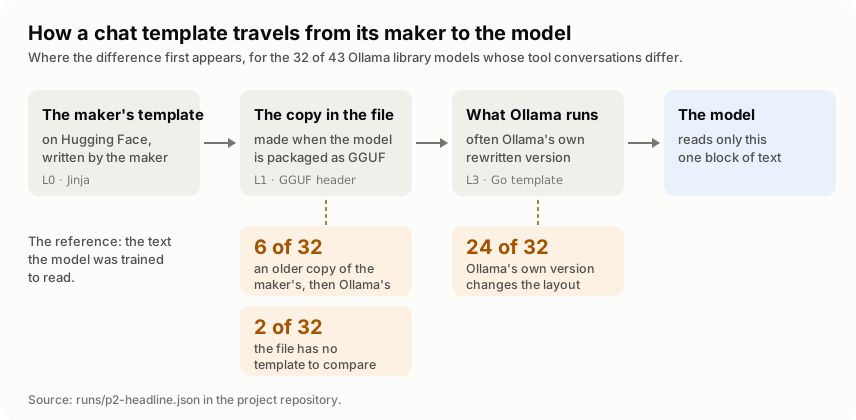
The project puts the same twelve harmless practice conversations through all three, and compares the exact text the model would receive. When the texts differ, it sorts the difference into a plain category. For example:
- “the default instructions were dropped”;
- “tool descriptions arrive in a form that isn’t JSON”;
- “only spacing changed”.
What makes the numbers trustworthy
- Ollama’s own code does the Ollama step for 41 of the 45 library model files. A small helper
program loads Ollama’s real template code (version 0.40.7) and runs it, so nothing is guessed.
For the Hugging Face models and three library models, Ollama uses a separate engine, which the
project reproduces in Python. The last library file,
gpt-oss, uses a format of Ollama’s (“harmony”) that the project doesn’t reproduce, so it isn’t scored.- It was checked against a real, isolated Ollama: the texts matched byte for byte on 12 of 12 practice conversations.
- The rule Ollama uses to pick a template was copied line by line. It passes all nine of Ollama’s own tests for that rule.
- No model is ever run, and no large file is downloaded. Only the first few megabytes of each model file, where the template is stored, are read over the internet.
- The sorting was checked by hand first. 52 differences were labelled by hand before the
sorting code existed.
- The code’s rules were tuned on 24 of them and then frozen.
- Then it was scored once on the other 28: it agreed with the hand labels on all 28.
- Those 52 came from one family of models (Qwen 2.5), so for the 65-model measurement every model flagged as different was also checked by hand. The notes are in P2-RESULTS.md.
- Old problems aren’t presented as new. Differences that are already reported to Ollama are marked with a link to the existing report.
- Every number has a source. Each figure on this site comes from a saved run or from a cited
publication, and every download is logged with its address, time and size. The runs behind the
results page are published in the repository’s
runs/folder, and the charts are drawn from them byscripts/site_figures.py.
How the check-up decides
The quick check-up is separate from the measurement. It only reads:
- Network: the list of open network ports your computer already keeps, to see which address each AI app listens on.
- Version: Ollama’s version number, asked from Ollama itself on
127.0.0.1. That’s the only connection the check-up makes. - Models: the names and chat templates of your installed Ollama models.
- Secrets: the names of files in the folder you point it at.
- Saved chats: whether the usual chat files exist, and their sizes.
It never opens a file’s contents, apart from your models’ chat templates, and it changes no settings.
Running the full measurement yourself
This part is for people comfortable with a terminal. The quick check-up needs none of it.
You need:
- Python 3.12 or newer, with
jinja2. -
The Go helper, built on Linux or in WSL on Windows:
bash go-helper/build.shSet
TDA_WSL_DISTROandTDA_GO_HELPERif your setup differs from the defaults.
Install the project:
pip install -e .
Then run any of these:
tda local
tda library --mapping population/mapping.yaml
tda hf --mapping population/mapping.yaml
tda report runs/<run-id>
tda localcompares the models on this computer.tda librarycompares the popular Ollama library models.tda hfcompares the popular Hugging Face models.tda reportrebuilds a run’s report.
The technical record
The design and each stage’s results are kept in the repository, in the order they were made:
- DESIGN.md: what is measured and why, and the threats to validity.
- P0-RESULTS.md: the feasibility spike, and the live check against a real Ollama.
- P1-RESULTS.md: the classifier, the hand-labelled set and the pipeline.
- P2-RESULTS.md: the measurement of the popular models, the hand review, and the check-up’s warning rate.
- labels/GUIDE.md: every category, with its meaning.
- population/README.md: how the 80 popular models were chosen and matched to their makers.